The new gas tank was fitted and cover was riveted in place. Routing the fire extinguisher lines was also done. This is an option that should be ordered by every track enthusiast. It is best to install during the initial build as it is much easier to route the lines. Installing it after the car is finished will not be quick nor easy!
Wednesday, September 26, 2012
Mono Build Entry #5
We received a large batch of parts from BAC and have taken inventory. We began assembling again after reviewing our build plan.
The new gas tank was fitted and cover was riveted in place. Routing the fire extinguisher lines was also done. This is an option that should be ordered by every track enthusiast. It is best to install during the initial build as it is much easier to route the lines. Installing it after the car is finished will not be quick nor easy!

We also bolted the hubs to the uprights. Note the trick green paint marker that confirms the bolt was torqued. All four of the uprights are the same and also use the same hubs. This is a welcome design for assembly and service feature. We need to press in one more bush (which is in the freezer shrinking) into a wishbone and we will be ready to install them.
The new gas tank was fitted and cover was riveted in place. Routing the fire extinguisher lines was also done. This is an option that should be ordered by every track enthusiast. It is best to install during the initial build as it is much easier to route the lines. Installing it after the car is finished will not be quick nor easy!
Sunday, September 2, 2012
Suspension Testing: Spec:Race Atom & Lotus Street Nitrons
We tested and conducted suspension development on both the Lotus Elise and Spec:Race Atom last week at Spring Mountain. We had a new street suspension from Nitron that needed a proper track test and also recruited Dave T. to help dial in the SRA's suspension. After four days of testing and tweaking, we achieved good results.
Nitron Street Series for Lotus Elise/Exige:
We have been working with Nitron to develop an affordable alternative to a stock Lotus suspension. Typically most OE shocks are showing wear by 40k miles. The degradation happens slowly, so most people don't notice that their shocks are worn out. These Nitrons feature valving that is fixed. The adjusters shown in this picture will not be on the final parts. A key feature of these shocks is that they have a threaded body which allow for ride height adjustment and corner balancing. The stock shocks do not allow any adjustment.
We installed the test set of shocks on a normally aspirated Elise with stock rims and Toyo R888 tires. We set the ride height to a stockish 135-140mm. I drove the car on Spring Mountain's 2.2mile config and rode up every bump and curb that I could. I put 277 track miles on the car and set a fast lap of 1min 58s with dozens of laps under 2min. A fast time is about 2min on this configuration. Overall the suspension performed beautifully. It was compliant and delivered great grip. Yes, it sways, pitches and squats more than a Nitron NTR series but it is designed as a street shock that may see occasional track use. We will now place it onto a street car and run through some street testing to confirm that it works properly on the street as well.
Spec:Race Atom Suspension Tuning:
West coast tracks can be quite bumpy and a real challenge for stiffly sprung cars. Previous track testing that I conducted with our SRA showed that it is very stiffly sprung. The SRA features double adjustable coil-overs with a bell crank and pushrod suspension. The car comes stock with 400# front and 500# rear springs. I spent one weekend at Spring Mtn with the car, comparing it to an Atom3 with the Bilstein adjustable shocks. The Atom3 was far more compliant through bumps that would fully upset the SRA. I called the factory and they suggested I test the softer springs they had sent with the car.
I asked our Ride & Handling expert, Dave Thilenius to help us set up the SRA. We decided to test spring rates on Saturday and then vary rebound and compression on Sunday. Rebound and compression settings were left alone as we first tested the following rates:
Nitron Street Series for Lotus Elise/Exige:
We have been working with Nitron to develop an affordable alternative to a stock Lotus suspension. Typically most OE shocks are showing wear by 40k miles. The degradation happens slowly, so most people don't notice that their shocks are worn out. These Nitrons feature valving that is fixed. The adjusters shown in this picture will not be on the final parts. A key feature of these shocks is that they have a threaded body which allow for ride height adjustment and corner balancing. The stock shocks do not allow any adjustment.
We installed the test set of shocks on a normally aspirated Elise with stock rims and Toyo R888 tires. We set the ride height to a stockish 135-140mm. I drove the car on Spring Mountain's 2.2mile config and rode up every bump and curb that I could. I put 277 track miles on the car and set a fast lap of 1min 58s with dozens of laps under 2min. A fast time is about 2min on this configuration. Overall the suspension performed beautifully. It was compliant and delivered great grip. Yes, it sways, pitches and squats more than a Nitron NTR series but it is designed as a street shock that may see occasional track use. We will now place it onto a street car and run through some street testing to confirm that it works properly on the street as well.
Spec:Race Atom Suspension Tuning:
West coast tracks can be quite bumpy and a real challenge for stiffly sprung cars. Previous track testing that I conducted with our SRA showed that it is very stiffly sprung. The SRA features double adjustable coil-overs with a bell crank and pushrod suspension. The car comes stock with 400# front and 500# rear springs. I spent one weekend at Spring Mtn with the car, comparing it to an Atom3 with the Bilstein adjustable shocks. The Atom3 was far more compliant through bumps that would fully upset the SRA. I called the factory and they suggested I test the softer springs they had sent with the car.I asked our Ride & Handling expert, Dave Thilenius to help us set up the SRA. We decided to test spring rates on Saturday and then vary rebound and compression on Sunday. Rebound and compression settings were left alone as we first tested the following rates:
- Baseline: Front 400# & Rear 500#
- Front 400# & Rear 300#
- Front 300# & Rear 400#
Carlos swapped the springs and reset the ride height to stock for each configuration. The pushrod on the SRA sets ride height - which is much easier than on a Lotus. We ran 1 warm up lap, 2 hot laps and 1 warm down for each configuration. We then ran the car on the skid pad in both Clockwise and Counter Clockwise directions. The SRA comes with Race Technologies data logger, dash and video. We downloaded the data after each session to see what the data revealed. Dave also took notes after each session to record his impressions. Watch the video below to hear some of his comments from one test session.
The skid pad became the test that best determined the balance of the car. It was clear that the first and third spring config were the best balanced. The second config. delivered a car that understeered more than the others - the softer spring kept the rear planted! The skid pad lap times were also the quickest in the third set-up. Actual lap times were close but we ultimately used Dave's qualitative comments to select the third (Front 300# & Rear 400#) spring config. This set up managed to soak up the bumps better than the first and delivered a neutral car. Dave did suggest that the second config. would be the most comfortable to drive for beginners.
On Sunday, we began to vary the Rebound and Compression settings. The QA1 shocks that come standard on the SRA feature 18 clicks of adjustment for each variable. Again we downloaded data and recorded comments to evaluate the handling. We tested ten different settings. Dave ended up running lap times that were significantly quicker than on Saturday.
I tested the SRA at the end of the day - I couldn't let Dave have all the fun! I'm at least as fast as the average Atom driver so felt my opinion would be relevant for most. The car was much better than the original with plenty of grip through the bumps. It was more compliant but remained stiff. Unlike with the original set-up, I was able to climb the curbs with confidence. Ultimately, we landed on settings for the SRA that I think are better suited for bumpier tracks. Great job Dave and Carlos for wrenching!
The Atom will always be a 'loose' car, especially when compared with other cars - like a Lotus. The SRA has no wings so remains a car that relies solely on mechanical grip. The rear bias and power-to-weight ratio make it a car that is even closer to a formula car. This is not a beginners track car nor one for the faint-of-heart. Even with our tuning, you need to keep a high level of focus to go quickly. I suspect this is one of the reasons why the Atom delivers excitement in spades...this car is not for wimps!
Wednesday, August 15, 2012
Mono Build Entry #4
Today we received a couple of presents from Cosworth! Two engines came in today from Cosworth that are ready to be bolted together with the Hewland sequential and put to life. Some prep work needs to be done on the gearbox and bell housing before we will be able to squeeze the assembly in the chassis, but that's the fun part!
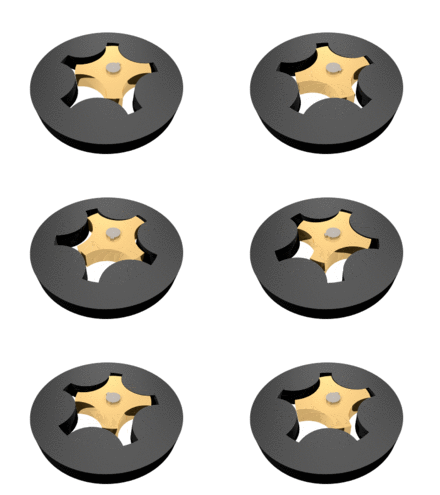
Oil Pump Gear Development
We began working on an uprated oil pump gear last year but put the project on hold as other developments took priority. We have begun working on it again this past Spring. This entry is an update on an effort that is not yet complete. As one of my old Ph.D colleagues from 3M Automotive used to say, "R&D ain't easy"!
The factory oil pump gear is a known weak link in the 2ZZGE engine in cars that see track use. We believe that a combination of high rpm (7k+) coupled with oil starvation (we know how to fix this) creates a hostile environment for these stock gears. Sintered metal parts start out as powder. This powdered metal is compressed in a shape, heated in a controlled environment and then machined to create the final part shape. This is a cost effective method to produce parts that require tight tolerance. The oil pump gear is considered a gerotor (see Wikipedia) type. As the inner and outer gears interact with each other, oil keeps them from grinding on each other. If the oil is starved from this system the gears will destroy each other causing all loss of oil pressure and bigger problems for your engine. If the gears are made from a brittle material they will be even more vulnerable.
We started working on a solution last year that we believed would be an effective replacement. We had it made from billet 4340 steel, REM finished and precision ground. We tested them on track and data logged our results. We blogged about it: HERE. We thought we had a good product until we removed it from our engine to inspect it. The gear teeth had deformed. Clearly it was not ready for prime time so we went back to the drawing board.
Our supplier is a well recognized and experienced gear manufacturer. They scratched their heads for some time as well and delivered a couple of new gears. These had some changes that they believed would improve performance.
We installed the first configuration and took our test Elise to our race shop at Spring Mountain for testing. We put about 290 track miles on the gear and recorded the conditions. Oil pressure looked great and the car ran fine. We removed the gear and found that we had made some improvement but still showed scoring on the teeth that was not acceptable. See picture below.
So the third configuration was installed and we headed back to the track. 250 track miles later we yanked out the gear and inspected it. This time we found the gears were in the best condition so far. In fact they exhibited some wear that you could see but could not feel. It was similar to the wear that we found on a Circuitworx gear that we had. We then looked at the oil pump housing and realized it was scored - but did that happen with the initial gear? Aarghh!!! (A Charlie Brown moment for sure). We bought a new housing and will be testing the gear again soon.
R&D is always a challenge in a small company but we feel this is the difference between simply fabricating a part and engineering a true solution. So back to the proverbial grindstone...we'll keep you posted as we continue our development on this product.
Friday, August 10, 2012
Mono Build Entry #3
![]() |
With the gas tank cavity assembled and awaiting the tanks
arrival, we have focused on the fire and brake bias systems (both options,
selected for chassis 0007) plus the front shear plate area of the chassis.
The optional fire system has six blue nozzles, two in the drivers
compartment, 4 in the engine bay. The following picture shows the two drivers
compartment nozzles, peeking out from behind the front roll hoop. The black boots on either side of the brake pedal cover the bias bar's clevises. When we have more of the interior installed, we will install the cable from the bias bar to the cockpit, allowing on-the-fly adjustment.
All of the fire system lines are hand formed, then test fit,
then sheathed with a fire resistant material. The bottle is attached to
the sub floor, with one line running fore (then immediately T'ing for the two drivers nozzles) and one line running aft. The blue masking tape on the right is to temporarily hold the aft line in place until we install the fuel cell.

Here you can see the
back side of the gas tank cavity, and all four nozzles in the engine bay. It is best to order this option initially, as adding it later is a challenge, especially once the cabin is fully built and trimmed.
Here we are up close and personal with 0007’s front shear
plate. This shows the careful attention to detail and integration that went
into the design of the Mono, with almost every bracket having multiple
functions (are those BAC guys channeling Chapman?). The billet front shear plate, for example, is a structural member of
the chassis that also holds the steering rack, wishbone mounts, and the front
storage box bracket. The storage box bracket, in turn, also holds the reservoirs
for the clutch and brake systems. Clever and beautiful!
![]() |
Monday, August 6, 2012
Mono Build Entry #2
Now that most of the parts are out of the boxes and in order, we start to assemble. We are going to start with the gas tank cavity, and since the gas tank is right in front of the engine we need to put some sexy gold heat wrap around the bulkhead panel that the tank sits in.
Like everything with this car, it all has to be fitted and measured, it does not come prefitted and cut. So we have to cut it to size and make sure it's perfect.
After the panels are all dressed up, we can start to assemble the rest of the cavity using about 100 rivets and install the tank.
Friday, July 27, 2012
Mono Build Entry #1
The BAC Mono has arrived, partially. We received a giant wooden box with the parts carefully packed inside; definitely not the way customers receive their Lamborghini Reventons! We get Monos in Semi Knockdown Kits (SKDs) which require assembly.
The Mono PDI(pre-delivery inspection) is also a bit different than a normal car. We have to assemble ours from scratch, and when say I scratch, I mean scratch. We have to assemble the assemblies that are bolted onto the vehicle.
We are starting the build of the Mono now and will slowly assemble the first vehicle to make sure everything is well documented and with the kind of attention to detail this car deserves.
We will post frequently, so check back often!
Thursday, July 12, 2012
Lotus Cup Laguna Seca 2012
What a weekend! This was the first time at Laguna for Glen, and he once again proved to be a quick study, learning the track quickly and accurately during our Saturday afternoon practice sessions. This proved to be instrumental to our success, as we lost the last portion of the final practice session on Saturday and the entire first session on Sunday, due to a mechanical issue with the Art Car’s engine. Racing has an amazing ability to bring any weakness in preparation and equipment to the surface, which is what makes competition valuable for us as a learning experience. As we all know, sometimes learning experiences are not easy!
During Saturday’s last session Glen had been turning laps in
the mid to high 1:40’s, still learning the track. On the 7th lap, he
had an issue entering the corkscrew which ended in a spin. After he got going
again, the car suddenly lost power. He brought the car immediately to the hot
pits, and it was apparent the car was randomly misfiring. The decision was made
to abandon the rest of the session and get the car back to the truck for a
closer inspection.
With the car back in the pits, imagine our surprise when we
found the entire intake and blower assembly loose from the cylinder head!
Working back through the sequence of events leading up to the race, it became
apparent what happened. We had recently installed an air temperature sensor in
the intake manifold, for measuring the temperature of the intake charge. When
the manifold was re-installed the top two fasteners (of 5 total holding the
intake / blower assembly to the cylinder head) were incorrectly torqued,
leaving the bottom three studs highly loaded from the belt tension and
eventually shearing them all off!
Picture Showing Top Fasteners, which loosened up, placing additional
stress on the lower fasteners
Picture Showing Center, Lower, Stud on the Intake, One of the Three
which were damaged at Laguna
With the problem identified, we set out to remove the
components required to access the broken fasteners, still at that point not
certain they could be extracted with the engine in place. With the blower,
intake manifold, fuel rail and injectors, plus throttle body out of the car,
the guys gained enough access to go to work.
Armed with a drill motor, center punches, hammer, and
borrowed left hand drill bits (THANKS TO ROBB BANNANO!) we set about extracting
the broken studs. By 10 p.m., all were out with no damage to the cylinder head,
and the engine was ready for re-assembly.
Sunday morning, we arrived early and thanks to the generous help of Rob Dietsch of Dietsch
Werks in San Jose,( www.dietschwerks.com, THANK YOU ROB!!!) we had new studs
and flange nuts to replace the ones we lost on Saturday. Working through the
first practice session we were able to get the Art Car re-assembled and back to
her former self!
Moral of the story: Always use the proper torque specification on any
fasteners.
After a quick run test in the pits using the data system to
verify all engine parameters were in spec, we were ready to go for the second
and final practice session. Glen turned consecutive mid 1:38’s on the 4th
and 5th laps on worn tires, and the car was working well.
The next session was time-attack qualifying, and with a
fresh set of tires Glen and the Art Car ripped off a 1:36:62 on the second
flying lap, a truly impressive performance.
In the race, after an epic battle with Kevin,
Glen managed to win the Open Class, and take Third overall, with only Andy and
Robb in 211’s ahead. This was the best possible way to end our weekend, and
certainly Glen’s performance on Sunday made our aching muscles from Saturday
night well worth it!
Tuesday, May 15, 2012
Lotus Cup Infineon 2012 - Power to Weight!
The Infineon race is now officially in the books and we are back in the office. We achieved an Open Class win on Friday and a second place on Saturday. Glen worked hard to stay with the 2-11s and managed to set the second fastest lap of the weekend which put him at P2 for Saturday's race. On Friday, he started P3 as both Andy and Robb inched us out by .5sec. Overall we are happy with the results as Infineon has a significant amount of elevation change which challenged our Art Car.
There were five 2-11s competing in the race weekend and a total of about 20 Lotus. You can see from the first picture that the 2-11s dominated the front of the grid. We recognize that competing with these lighter cars is a challenge but it is the type of effort that keeps us on our toes. We reduced the weight of the Art Car before this race by replacing the windshield with our new OpticArmor Lexan Winscreen. For improved comfort, we installed a heavier Recaro race seat from Glen's Elise, so lost some of the 16lb savings that the Lexan Windscreen provided. Still the Art Car weighed 2009lbs with driver and full of fluids - which is about 180lbs heavier than the 2-11s.
To improve our lap times, we tried several tactics, including suspension adjustments and even added a larger ReVerie rear wing to our car (1700mmx300mm vs. 1700mmx200mm). We added the larger wing on Sat. morning and it gave Glen some added rear grip to address the oversteer that was challenging us all weekend long. Glen then nailed a lap time that beat all the times set on Friday. We were excited about the result, but his time would not stand for too long. Andy soon layed down a scorching time that would remain the Fastest Lap of the weekend! Ultimately Robb won both races with his blue 2-11 seen in these pix. Congrats to Robb!Infineon has several cresting corners that are off camber and in some cases blind. See pics above and below. The climb into the first two corners was especially a challenge as the elevation change is significant. The next race will be Laguna Seca which also has two big climbs that will be difficult. Lighter cars have distinct advantage in these conditions - both ascent and descent. 2-11s are amazing cars and Lotus have done a fine job with them. They can be trickier to drive than the Elise/Exige but they have amazing potential and remain the cars to beat! But we knew that going into this season...8^)
Subscribe to:
Posts (Atom)

.jpg)