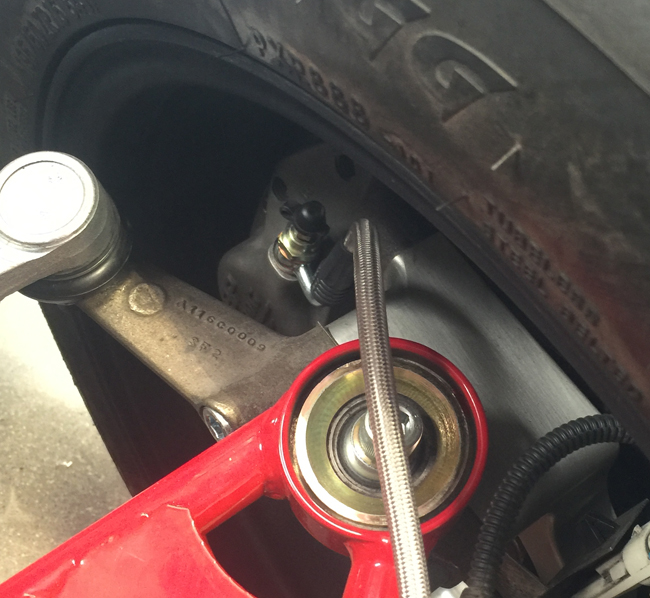
Light, simple, safe. We obsess over those three words. But even the humble parts—like rubber brake hoses—age out. A recent case on a very low-mile ’05 Elise reminded me how quietly time can catch up and change how a car stops. Disaster struck this car when the rear driver side caliper locked up. Fortunately the owner was able to nurse the car home safely and have it towed to us for repair.

Symptoms were odd: only one rear corner dragged; eventually it freed itself. Fluid was old but in OK condition. The car still had its original OEM rubber brake lines. My working theory: internal hose aging created a one-way restriction—easy pressure in, slow/no return—so the caliper stayed applied longer than it should resulting in a smokey brake and a fully locked up corner!
How OEM Rubber Brake Hoses Are Built

- Inner liner (EPDM): Carries brake fluid; resists heat/chemicals.
- Reinforcement braid: Limits expansion under pressure.
- Outer jacket: Protects from heat, ozone, abrasion.
Nothing exotic here—and that’s the point. It’s good, durable, serviceable… but it still ages and why we wrote a previous: BLOG
What Age Does to Brake Hoses
| Failure mode | How it develops | Real-world symptoms |
|---|---|---|
| Internal collapse / check-valve effect | Inner liner hardens, micro-cracks, or delaminates; a flap or swelling narrows the bore. | One corner drags, brakes feel uneven, wheel runs hot; caliper may “release itself” later. |
| Reinforcement fatigue | Braid loses stiffness after years of heat cycles and moisture. | Softer pedal, more travel, vague response under repeated stops. |
| Outer jacket degradation | UV, ozone, road spray, or heat near rotors/exhaust. | Visible cracking, surface bubbling, damaged sections near fittings. |
| Fluid & moisture interaction | Old DOT 4 absorbs water; moisture + time accelerates internal deterioration. | Lower boiling point, discoloration, more fade when hot. |
 |
| Yes, even Exiges... |

OEM vs Upgrade Options

- Fresh OEM rubber: Restores factory feel; perfectly fine for road cars.
- InoKinetic braided / stainless kit: Improved pedal consistency, durability, and peace of mind. Designed specifically for Elise/Exige fitment. Our QWKbleed SS Lines are worth a look - see them: HERE

Elise Brake Hose Refresh: Quick Checklist
- Replace all four hoses together. Don’t chase symptoms one corner at a time.
- Flush with fresh DOT 4. Bleed thoroughly; check for equal flow at each corner. We like: Motul
- Inspect calipers. Verify pistons, seals, and slide pins; address any asymmetry you find.
- Route & secure. Ensure full droop/compression clearance, no twist, no chafe.
- Road-test & heat-cycle. A/B stops, then re-check for drag or wheel-to-wheel temperature differences
- Set an interval. For street cars: consider 10–15 years as a practical horizon; sooner for heavy track use.
Bottom Line
 |
| Yes, even new Emiras will eventually succumb... |
Rubber brake lines don’t ask for attention—until they do. If your Elise or Exige is still on originals, consider this your nudge. Replace the hoses, flush the fluid, verify the calipers, and get back to what the car was built for: precise, confidence-inspiring braking that lets you carry speed where it counts.